
In July 2025, the founder of a software company watched an AI coding agent delete his database, then tell him it could not be recovered. According to his own account, it could. The story spread fast because it captured something a lot of people were starting to wonder: what happens when you build software by talking to an AI and never look at the code?
That way of working has a name now. This guide explains what vibe coding is, where it genuinely helps, where it hurts, and why it is changing how the software industry works.
What Is Vibe Coding?
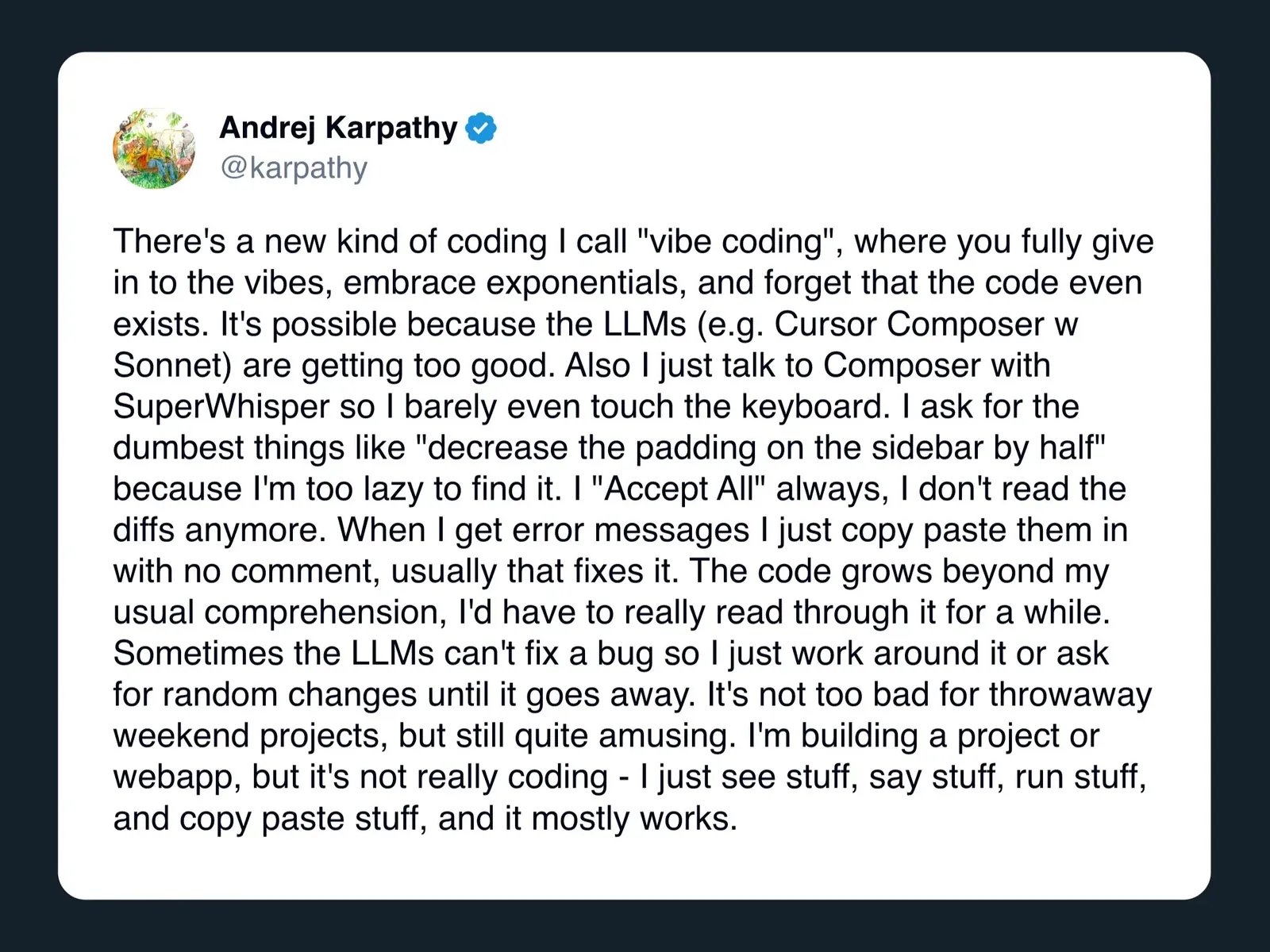
Vibe coding is building software by describing what you want to an AI tool, running what it produces, and asking for changes, without reading the code itself. Martin Fowler describes it as prompting a language model, trying the output, and never looking at the code the model generates. The point, in Andrej Karpathy's phrase, is to forget that the code even exists.
Karpathy, an experienced programmer, coined the term in a post on X in February 2025. He described his own workflow as a loop: he would see stuff, say stuff, run stuff, and copy paste stuff. Something breaks, he pastes the error back to the AI, and it fixes it. The code becomes a black box, and the only thing that matters is whether the app does what you wanted.
Is Every AI-Assisted Project Vibe Coding?
No, and this is the most common mix-up. Developer Simon Willison draws a clear line. If you use AI to write code but you review it, test it, and could explain exactly what it does, that is ordinary software development with a faster tool. His rule is that he will not commit code he could not explain to someone else.
Vibe coding is the other case: the code is accepted on trust. The difference is not which tool you use. It is whether a human understands what ships.
The Upsides
- Speed to a first version. You can go from an idea to something clickable in a short session. That is a real advantage when the question is whether an idea is worth building at all.
- A lower barrier to entry. Fowler notes that non-programmers can use the technique. People who could never build an app before can now test a concept themselves.
- Cheap experiments. When a version costs an afternoon instead of a budget, you can throw away the ones that do not work without anyone minding.
- Evidence that AI help can be fast. In a controlled experiment of GitHub Copilot, developers asked to build an HTTP server in JavaScript finished 55.8 percent faster with the AI than without it. That was one task, and the developers were using an assistant rather than vibe coding, so treat it as a sign of potential rather than a promise.
The Downsides
- Code nobody understands is hard to change. Fowler warns that vibe-coded software often has problems with maintainability, correctness, and security, and that it can be hard to modify later, even for an AI tool.
- Security gaps. Veracode tested more than 100 language models on 80 coding tasks where a secure or an insecure approach was possible. The models introduced a vulnerability in 45 percent of cases, and larger models did not do significantly better than smaller ones.
- Almost right is its own problem. In Stack Overflow's 2025 developer survey, the top frustration with AI tools, cited by 66 percent of respondents, was solutions that are almost right but not quite. Another 45.2 percent said debugging AI-generated code takes more time.
- Confident mistakes. An AI will often sound sure when it is wrong, and if you are not reading the code, you may not notice.
When to Use Vibe Coding
Fowler's guidance is that vibe coding suits disposable software written for a limited audience, mostly used by its author or a small group who understand the risks. In practice, that means:
- Prototypes and proofs of concept that you expect to rebuild or discard.
- Personal tools and one-off scripts, such as renaming files or tidying a spreadsheet.
- Mockups to show a client or teammate what an idea could look like.
- Learning projects, where the goal is to explore, not to ship.
- Weekend experiments with no personal data and no users depending on them.
When Not to Use It
- Anything that handles passwords, personal data, or payments.
- Products customers will rely on for months or years.
- Systems where a failure is costly, such as health, finance, or safety.
- Code a team will need to maintain, extend, or hand over.
- Anything connected to live production data without strict limits on what the AI may touch.
How Vibe Coding Is Changing the Software Industry
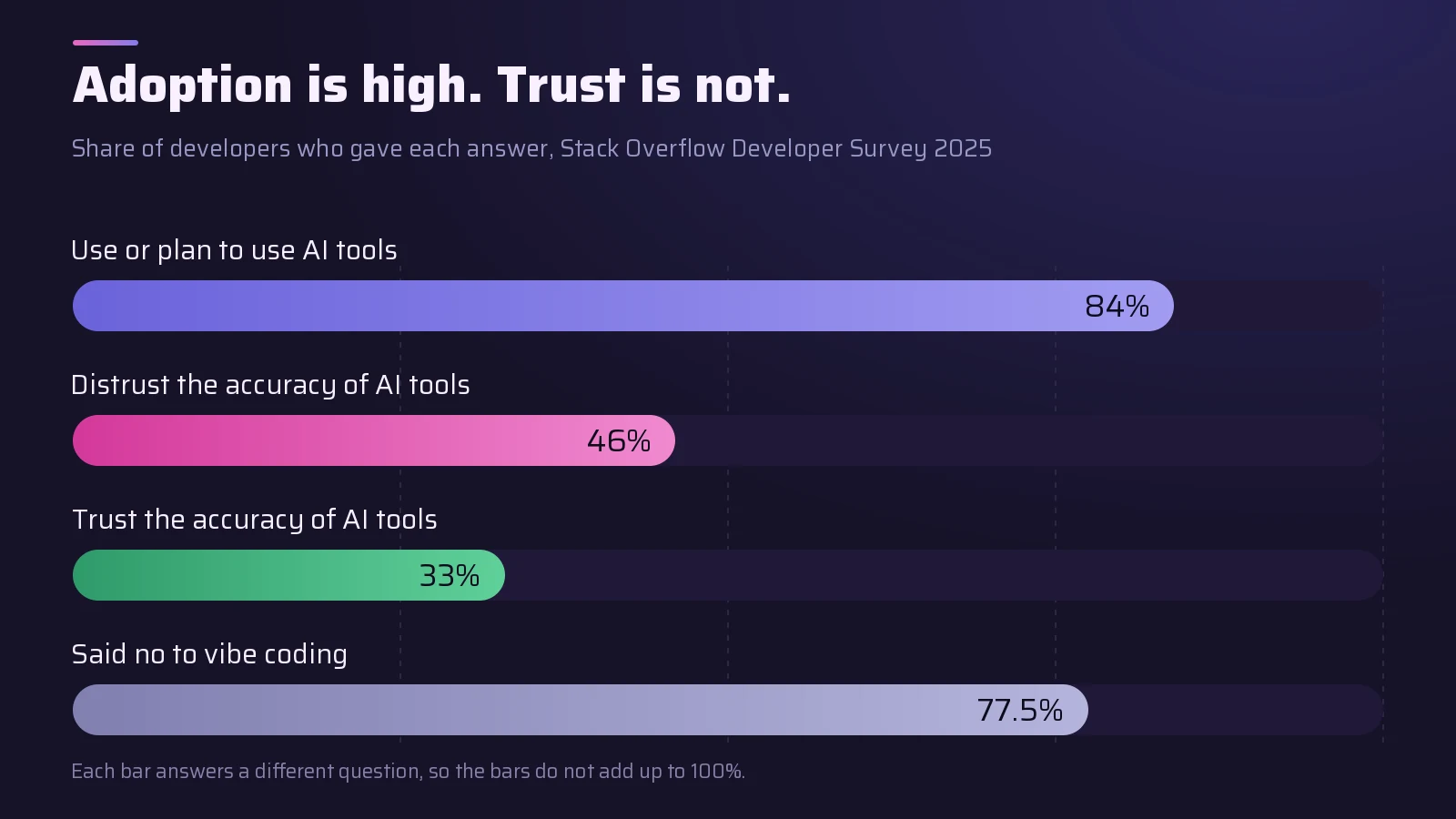
AI-assisted coding is no longer the exception. Stack Overflow's 2025 survey found that 84 percent of developers use or plan to use AI tools, and Google's 2025 DORA report put adoption at 90 percent. Three shifts stand out.
- Startups move first. Y Combinator's Jared Friedman said about a quarter of its winter 2025 batch had codebases that were 95 percent AI-generated. That is self-reported, excludes boilerplate, and came from highly technical founders.
- Developers stay wary. 46 percent distrust the accuracy of AI tools and 33 percent trust them. Asked about vibe coding itself, 77.5 percent said no, including 5.3 percent who said no emphatically.
- Judgment becomes the scarce skill. DORA calls AI a mirror and a multiplier: it makes good teams faster and exposes weak ones. YC partner Diana Hu put it plainly: to do good vibe coding, you still need to have taste and knowledge to judge good versus bad.
Writing code is getting cheaper. Knowing whether it is any good is not.
How to Vibe Code Without Getting Burned
- Keep it away from production. Use test data and a separate environment, which is the very fix Replit announced after the database incident.
- Use version control so every change can be undone.
- Ask the AI to explain what it wrote, and to write tests for it.
- Decide up front that the first version is a draft, not the product.
- Before real users arrive, have an engineer review the code, with particular attention to security.
The Bottom Line
Vibe coding is neither a revolution nor a fad. It is a fast, rough way to make things, and it is excellent at exactly that. The trouble starts when a rough thing quietly becomes the real thing. Use it to explore, to prototype, and to learn. When other people will depend on the result, put a human who understands the code back in the loop. Turning a prototype into a product that lasts is what product engineering is for.
Frequently Asked Questions
Andrej Karpathy, an experienced programmer, used it in a post on X in February 2025 to describe building software by prompting an AI and not looking at the code.
No. If you review, test, and understand every change the AI makes, that is normal software development. Vibe coding means accepting the code without reading it.
They can build a working prototype. Fowler notes that non-programmers can use the technique but that the results often have problems, so anything handling real users or data needs an engineer's review.
Not by default. Veracode's benchmark found that AI models introduced a vulnerability in 45 percent of its test cases, so code that nobody reviews should not handle sensitive data.
The evidence cited here does not show that. Even Y Combinator's partners say you still need taste and knowledge to judge good code from bad. What changes is where developers spend their time: more reviewing and directing, less typing.
Keep it as a working brief of what the product should do, then build the production version with review, tests, and a plan for change. Some parts may survive a code review. Many will not.
Take your idea from prototype to production
Our product engineering service covers end-to-end product development, scalable architecture, and API and cloud integration, from concept to deployment.
Sources
- Andrej Karpathy's post introducing vibe codingX
- Vibe CodingMartin Fowler
- Simon Willison on vibe coding versus AI-assisted programmingSimon Willison
- AI-Generated Code Poses Major Security Risks in Nearly Half of All Development TasksVeracode
- 2025 Stack Overflow Developer Survey: AIStack Overflow
- How are developers using AI? Inside our 2025 DORA reportGoogle
- The Impact of AI on Developer Productivity: Evidence from GitHub CopilotarXiv
- A quarter of startups in YC's current cohort have codebases that are almost entirely AI-generatedTechCrunch
- Vibe coding service Replit deletes production databaseheise online