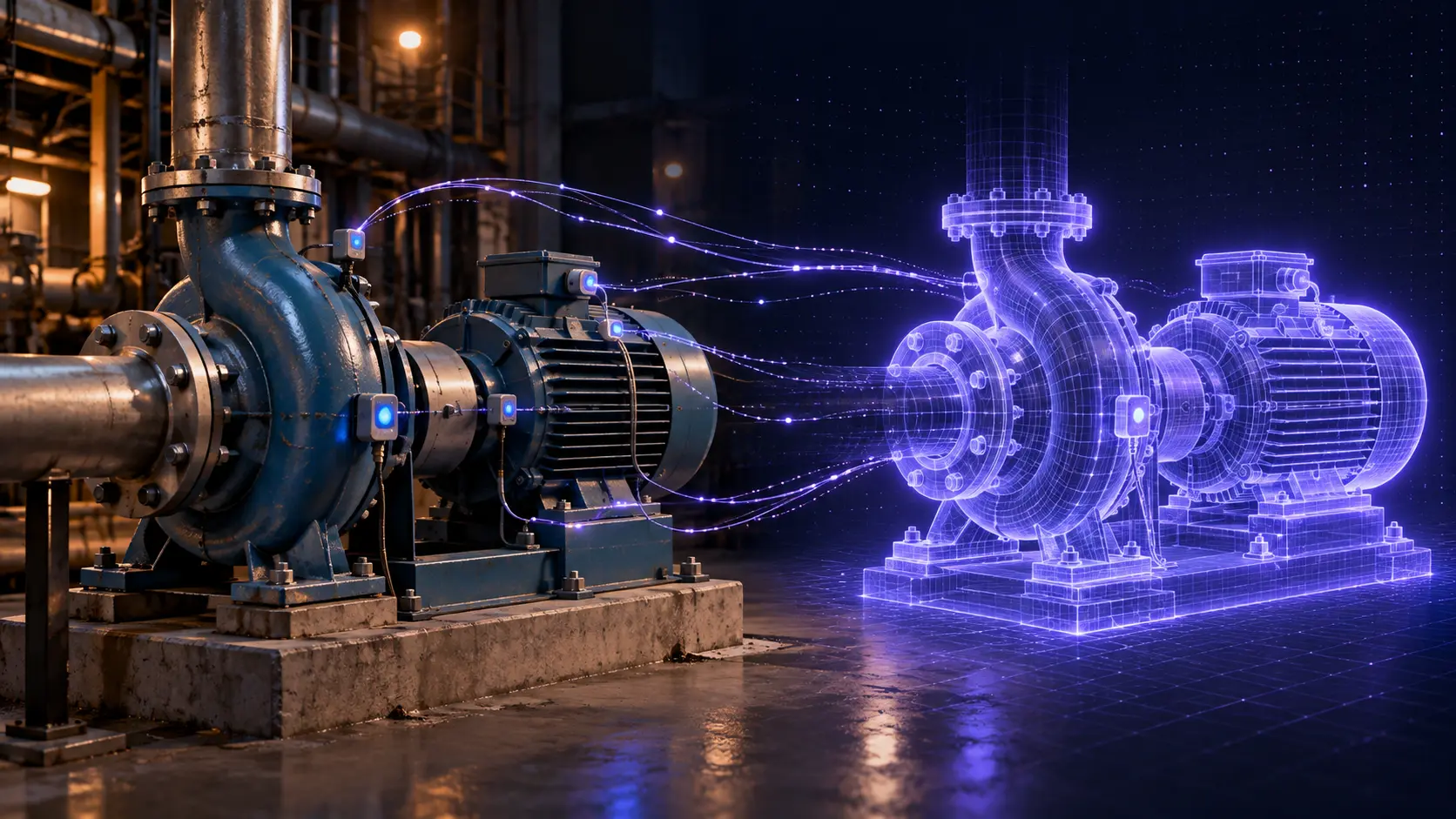
That live link is the whole point. It is what separates a digital twin from a 3D model, which shows how something looks, and from a simulation, which explores what could happen. This guide covers where the term came from, how a twin works, how it compares with its close relatives, and how to tell whether your project needs one.
Where the Term Comes From
The idea is older than the buzzword. According to a widely cited review by Kritzinger and colleagues, Michael Grieves first described the concept in 2002, in an industry presentation on product lifecycle management, and it appeared in NASA's technology roadmaps in 2010.
In 2012, Edward Glaessgen of NASA Langley Research Center and David Stargel of the Air Force Office of Scientific Research gave a definition that is still quoted today. They described a digital twin as "an integrated multiphysics, multiscale, probabilistic simulation of an as-built vehicle or system that uses the best available physical models, sensor updates, fleet history, etc., to mirror the life of its corresponding flying twin." Their goal was to track the structural health of each individual aircraft, instead of relying only on fleet-wide statistics and safety factors.
There is still no single agreed definition. The US National Institute of Standards and Technology (NIST) says so directly in its 2025 report on digital twin security, and quotes the Digital Twin Consortium's description: a virtual representation of real-world entities and processes "synchronized at a specified frequency and fidelity." Those last two words carry the weight. How often the copy updates, and how closely it matches, depend on what the twin is for.
How a Digital Twin Works
Strip away the vocabulary and a twin has three parts.
- The real thing. A pump, an aircraft engine, a production line, a ship. NIST notes that a twin can also represent something with no physical form, such as a business process.
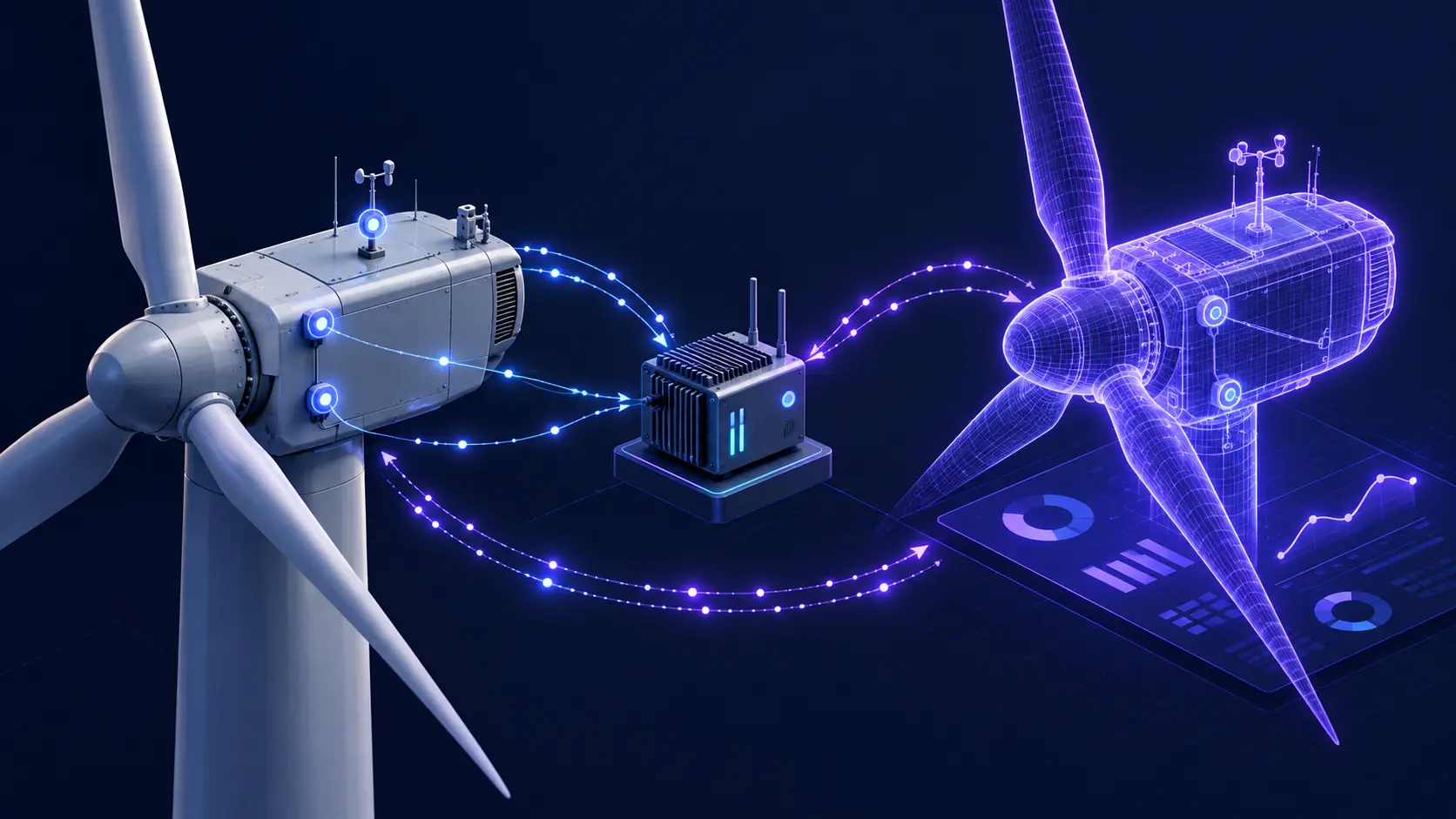
- A data link. Sensors on the real thing measure what matters, such as temperature, vibration, pressure or position, and send those readings to software. This is IoT sensor integration, and it is what keeps the copy current.
- A model that updates. Software holds a digital representation of the object and updates it as data arrives, so it shows the current state instead of the original design. People then read it through a monitoring dashboard, a 3D view, or VR.
NIST credits cheap networked sensors for much of the recent interest. Small, low-cost, battery-powered devices make it practical to measure objects that were never measured before, and the report notes that modern buildings may have thousands of sensors.
The data link is usually the hardest part to get right. The 3D graphics rarely hold a project up. Getting trustworthy readings out of equipment that was never designed to report anything is where timelines tend to slip.
Digital Twin vs 3D Model vs Simulation
Kritzinger and colleagues sort digital copies into three levels by asking one question: how does data move between the real object and the digital one?
| Level | Real to digital | Digital to real | What it looks like |
|---|---|---|---|
| Digital model | Manual | Manual | A 3D model, or a plan of a factory not yet built |
| Digital shadow | Automatic | Manual | A live view of a machine that updates from its sensors |
| Digital twin | Automatic | Automatic | A change on either side updates the other |
In a digital model, a change to the real object has no direct effect on the digital one. In a digital shadow, the real object updates the digital one automatically, but not the other way around. Only when data flows automatically in both directions do the authors call it a twin, and at that point the digital side can also act as a controlling instance of the physical one.
The review found that published work on the full twin was scarce compared with models and shadows. That is worth knowing, because a digital shadow is often exactly what a project needs: live visibility, without software sending commands to real equipment.
A simulation is different again. It runs a model forward to ask "what if", and it can run on a design that does not exist yet. NIST draws the line plainly: "Monitoring the state or condition of real objects is fundamentally different from simulation." A twin can contain simulations, which is how it forecasts, but a simulation on its own has no live link to one specific real object. When real data keeps a simulation current and its output feeds real decisions, you have a simulation feedback loop.
Where Digital Twins Are Used
NIST's report highlights four industries already exploring the technology:
- Drones. Remote operators rely on real-time information about the aircraft's state and condition, often from a control center far from the drone itself.
- Ocean-going vessels. 3D and VR views let designers and maintenance crews walk through a ship, and live monitoring during operation could reduce some physical inspections.
- Oil rigs and drilling platforms. Models of rigs and drill heads working at great depth, where direct inspection is difficult.
- Robotic surgery. Pre-surgery planning, and getting tools from different makers to work together.
Aerospace is where the idea took shape, as Glaessgen and Stargel's paper shows. The common thread across all of these is an asset that is expensive, hard to inspect, or dangerous to get wrong, where knowing its current condition is worth the cost of measuring it.
What It Takes to Build One
- A clear question. Decide what decision the twin should help someone make. Predicting a bearing failure and showing a site layout call for very different builds.
- Sensors and connectivity. The right measurements, at a useful rate, from equipment that may not have been built to share data.
- A model worth updating. A 3D representation, a physics model, a statistical model, or a mix, depending on the question.
- History. Predictive maintenance needs a record of what normal and failing behavior look like for that specific machine, and that record takes time to collect.
- Security. This is the focus of NIST's report. A twin gathers measurements from many sensors in one place and may allow remote control, which widens what an attacker could see or change.
When a 3D Model Is Enough
If the question is "what does this look like?" or "will this fit?", you need a 3D model, not a twin. Design reviews, space planning, sales walkthroughs and layout training all work from a static model. NIST counts viewing static models as one use of twin technology in its own right.
A twin earns its cost when the real thing changes in ways you need to see as they happen, or predict before they happen. If nothing about your question depends on the object's current state, the live link adds cost without adding answers.
Frequently Asked Questions
A digital copy of a real thing that stays up to date with it through live data, so you can see its current state from a screen, and sometimes predict or change it.
No. A simulation explores what could happen and can run on something that does not exist yet. A twin is tied to one specific real object and kept current by its data. Many twins use simulations to make forecasts.
It needs a live source of data from the real object, and sensors are the usual one. A copy that is only ever updated by hand is what Kritzinger and colleagues call a digital model, not a twin.
No. A twin is a live representation of a real thing. AI is one tool that can be applied to its data, for example to recognize patterns that come before a failure. A twin does not need AI to be useful.
Mainly the number and type of measurements, how hard it is to get data out of existing equipment, how detailed the model needs to be, whether the twin only monitors or also controls, and the security that follows from that. The range is too wide for a typical figure to be useful.
Planning a Digital Twin?
We help teams decide between a 3D model, a live dashboard and a full twin, then build the one their question needs.
Sources
- Security and Trust Considerations for Digital Twin Technology (NIST IR 8356)National Institute of Standards and Technology, 2025
- Digital Twin in Manufacturing: A Categorical Literature Review and ClassificationKritzinger et al., IFAC-PapersOnLine 51(11), 2018
- The Digital Twin Paradigm for Future NASA and U.S. Air Force VehiclesGlaessgen and Stargel, NASA Technical Reports Server, 2012