
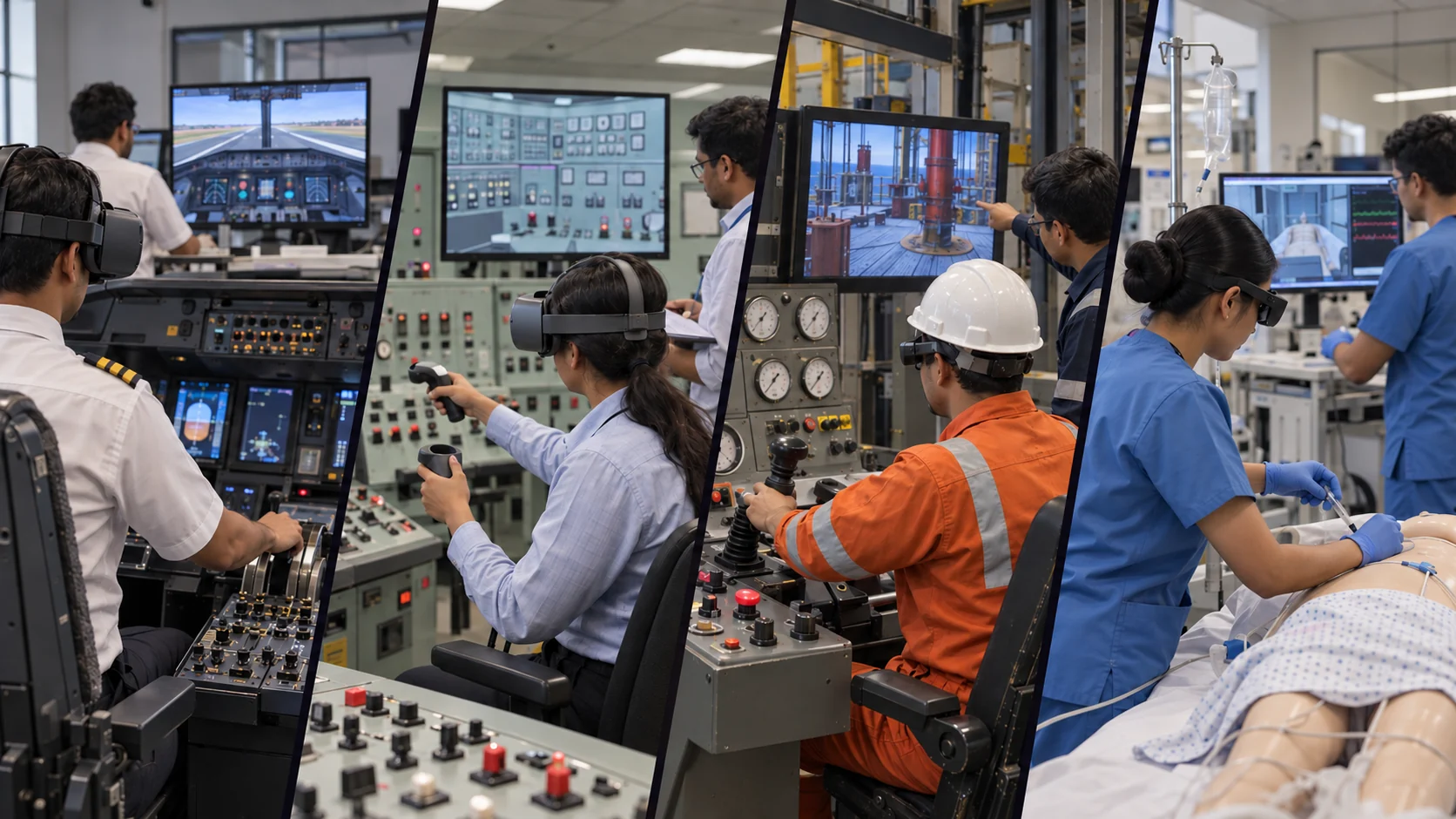
Some skills cannot be practiced on the job
An airline pilot may fly an entire career without a real engine failure on takeoff. A reactor operator hopes never to see a genuine emergency alarm. A doctor's first attempt at a difficult procedure has to happen on someone. In each case, the moment that matters most is the one nobody can safely rehearse for real.
That is the problem simulation solves. It moves practice of rare, dangerous, or expensive events into a setting where a mistake costs nothing and can be repeated until the response is right.
What simulation lets people do
- Rehearse rare events on demand. An emergency that might happen once in a career can be run ten times in an afternoon.
- Make mistakes safely. A wrong decision ends the scenario, not a flight, a shift, or a patient's recovery.
- Get measured feedback. Every action is recorded, so assessment rests on what the trainee did rather than on an instructor's memory of it.
- Practice until competent, not until time runs out. Training continues until a set standard is met, an approach known as mastery learning.
Where it is already the standard
Aviation
Commercial aviation has trusted simulators longer than almost anyone. Under the FAA's advanced simulation rules for U.S. airlines, a pilot can complete all pilot flight training and checking in a Level C or Level D full flight simulator. What still has to happen in the real airplane is a short list: supervised operating experience on actual flights, a line check, and a visual inspection of the aircraft inside and out.
Nuclear power
In the United States, nuclear plant operators are licensed partly on a plant-referenced simulator, a replica of one specific plant's control room. Federal rules allow it to be used for operating tests, for requalification training, and for the reactivity control manipulations an applicant must perform to become eligible for a license. They also require its models to replicate the most recent core load of the real plant it copies. The simulator is not a generic reactor. It is that reactor.
Industry
In oil and gas drilling, the moment a well starts to take in fluid it should not, known as a kick, is one that crews must recognize and control within minutes. The International Well Control Forum's drilling certificates at Levels 3 and 4 include a practical assessment on a simulator. The Level 3 candidate is assessed as the driller: setting up the drill floor, recognizing a drilling break, and responding to an influx in time. The Level 4 candidate is assessed as the supervisor: collecting the shut-in data, issuing kill instructions, and circulating the influx out. The certificates are valid for two years, so the skill is tested again, not assumed.
The process industry learned the cost of skipping this the hard way. On March 23, 2005, explosions and fires at the BP refinery in Texas City, Texas, killed 15 people and injured 180. The accident happened during the startup of a unit, one of the rarest and most hazardous operations a plant performs. The U.S. Chemical Safety Board found that simulators were unavailable for operators "to practice handling abnormal situations, including infrequent and high hazard operations such as startups and unit upsets." Internal recommendations to add simulator training had been made in the years before and were not funded. After the accident, the head of BP's own training department said: "We could have equipped every process unit across TCR [Texas City Refinery] with several simulators for what the ISOM incident will cost us." One of the Board's recommendations to the refinery was training on recognizing and handling abnormal situations, "including the use of simulators or similar training tools."
Medicine
In a 2009 study at an urban teaching hospital, 92 medical residents completed simulation-based training in inserting central venous catheters, and had to reach a set standard before doing the procedure on patients. After the trained residents joined the intensive care unit, catheter-related bloodstream infections there fell from 3.20 to 0.50 per 1,000 catheter-days. It was an observational study in one hospital, not a controlled trial, but the size of the drop is difficult to ignore.
The wider evidence points the same way. A 2011 review of 609 studies involving more than 35,000 health professionals found that, compared with no training, simulation was consistently associated with large gains in knowledge, skills, and behavior, and moderate gains in patient outcomes.
Where simulation falls short
Simulation is not a cure-all, and the research is clear about its limits.
- Against other good teaching, the gains are smaller. A 2012 review of 92 studies found that simulation's advantage over other instructional methods was small to moderate, not large.
- It costs more. In the five studies in that review that compared costs, simulation was more expensive, and also more effective.
- More realism is not always better. A 2022 analysis of 57 experiments found that no single level of realism worked best in every case. Medium-fidelity simulators produced the highest overall transfer to real work, especially for less experienced trainees.
- Some things still need the real environment. Even under the FAA's rules, operating experience on real flights stays in the airplane.
What a good simulation program gets right
- Scenarios drawn from real procedures and real incidents, not generic exercises.
- A clear standard for competence, and practice until it is met.
- Assessment built into the simulation, so progress is measured rather than estimated.
- Realism matched to the learner: simpler scenarios for new trainees, richer ones as skill grows.
- Recurring practice. Aviation and nuclear power both require recurrent or requalification training, because a skill used once a decade needs rehearsing more often than that.
How we approach it
At Simulated Sphere Innovations, this is the thinking behind our simulation and training work: training environments built around an organization's own procedures, with assessment designed in from the start. We are also building Sphere Training Platform, which is designed to let organizations create and run this kind of training themselves.
Sphere Training Platform
An enterprise platform for creating, deploying, and managing AI-powered simulation training across desktop, mobile, and XR.
Sources
- 14 CFR Part 121, Appendix H: Advanced SimulationU.S. Federal Aviation Administration
- 10 CFR 55.46: Simulation facilitiesU.S. Nuclear Regulatory Commission
- BP America (Texas City) Refinery Explosion: Investigation Report No. 2005-04-I-TX (2007)U.S. Chemical Safety and Hazard Investigation Board
- Drilling Well Control: Levels 3 and 4 practical assessmentInternational Well Control Forum
- Use of simulation-based education to reduce catheter-related bloodstream infections (Barsuk et al., 2009)Archives of Internal Medicine
- Technology-enhanced simulation for health professions education: a systematic review and meta-analysis (Cook et al., 2011)JAMA
- Comparative effectiveness of technology-enhanced simulation versus other instructional methods (Cook et al., 2012)Simulation in Healthcare
- The effect of simulation fidelity on transfer of training for troubleshooting professionals: a meta-analysis (Doozandeh and Hedayati, 2022)IISE Transactions on Occupational Ergonomics and Human Factors