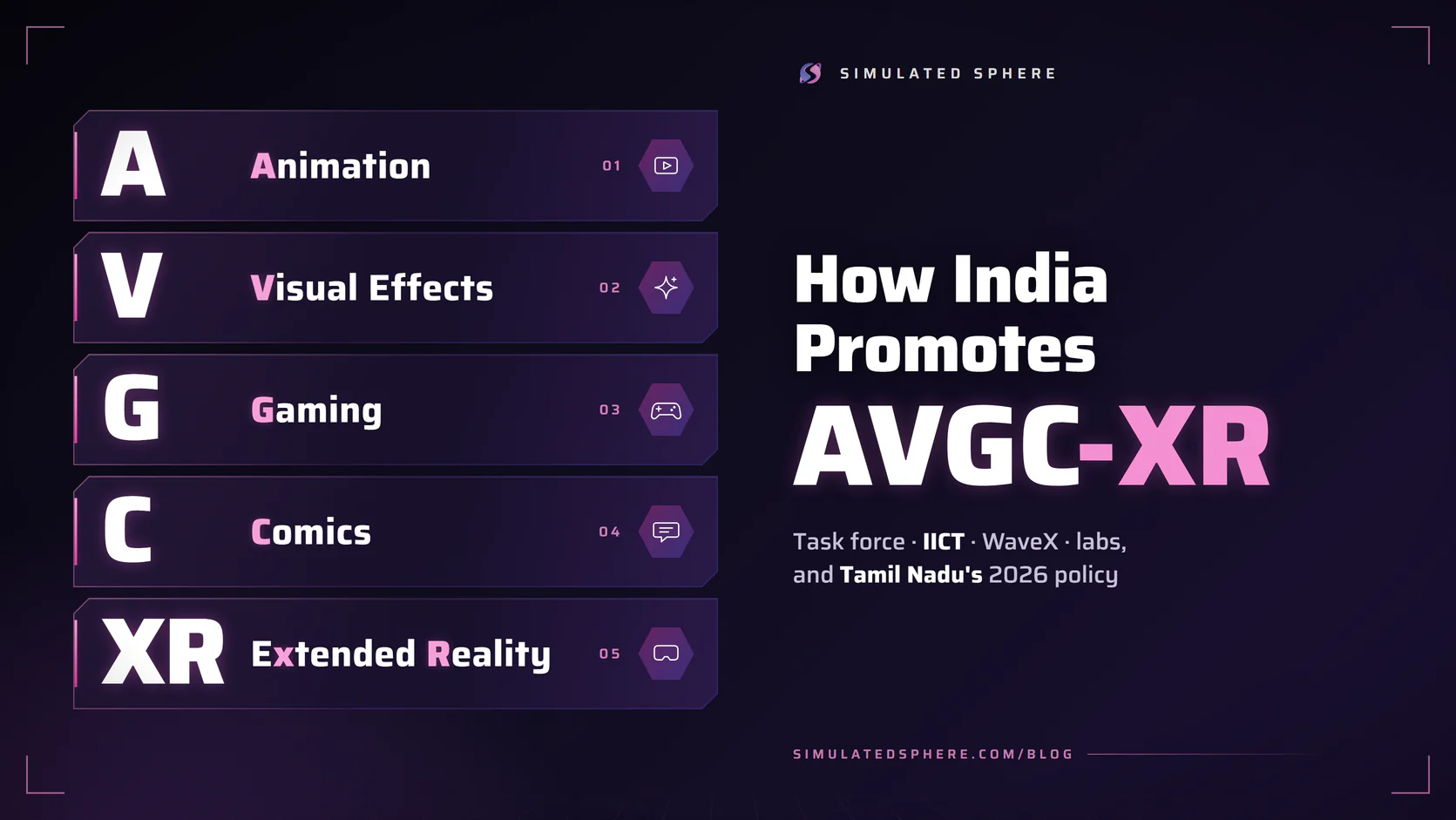
AVGC-XR stands for animation, visual effects, gaming, comics and extended reality. In the last few years the Indian government has treated these five areas as one sector worth building on purpose, not as a side effect of the film and IT industries. This article explains what has actually been set up, in the order it happened, and what Tamil Nadu has added at state level.
Why the Government Is Backing This Sector
A Press Information Bureau (PIB) explainer from November 2025 describes India's media and entertainment sector as heading toward roughly USD 100 billion by 2030. It also states that India has a 40 to 60 percent cost advantage in animation and VFX services, which is why so much global post-production work already comes here. The policy aim is to move from doing work for others to owning intellectual property (IP) made in India.
Skills are the other reason. The same document says the AVGC Promotion Task Force projected around 20 lakh direct and indirect jobs over ten years. A projection is not a guarantee, but it explains why most of the schemes below are about training.
Step One: The AVGC Promotion Task Force
In 2022 the Ministry of Information and Broadcasting set up the AVGC Promotion Task Force to design a national strategy. Its recommendations included a National AVGC-XR Mission with a "Create in India" focus. The task force also produced a model state policy so that states could write their own, which is where the state policies in this article come from.
Step Two: A National Institute, IICT
The Union Cabinet approved a National Centre of Excellence for AVGC-XR in 2024, to be based in Mumbai and modelled on the IITs and IIMs. It became the Indian Institute of Creative Technology (IICT), set up as a not-for-profit Section 8 company with industry bodies and the government as partners. The milestones in the PIB explainer are:
IICT is set up as a Section 8 company. Google, YouTube, Meta, Adobe, Microsoft, NVIDIA, Wacom and JioStar are onboarded as industry partners for curricula, internships and scholarships.
The first academic session is announced, with courses across gaming, post-production, animation, comics and XR.
The campus at the NFDC Complex in Mumbai opens with an initial budget of 400 crore rupees and a target of about 300 students in the first batch.
The WaveX media-tech startup incubator starts with a first cohort of 15 startups, offering mentorship, infrastructure and access to partners.
IICT signs an agreement with FICCI and Netflix on curricula, masterclasses and scholarships.
The PIB document gives the initial budget as 400 crore rupees. Other PIB material quoted in press coverage gives 391.15 crore, so treat the exact figure as approximate.
Step Three: Labs in Schools and Colleges
In the Union Budget 2026-27 the Finance Minister announced support for IICT in setting up content creator and AVGC labs in 15,000 secondary schools and 500 colleges, according to press coverage of the Budget. That coverage states no funding amount, and other reports quote different figures, so we have left a number out. The practical point is that the government plans to take AVGC tools into ordinary classrooms, not only into specialist institutes.
What States Are Doing
The national bodies set direction, but incentives such as grants, rebates and infrastructure mostly come from states. The PIB explainer names two:
- Karnataka has an AVGC-XR Policy for 2024 to 2029, focused on skilling, incubation and global competitiveness.
- Maharashtra approved its AVGC-XR Policy 2025 in September 2025, with a financial plan of 3,268 crore rupees and a roadmap to 2050.
Tamil Nadu's AVGC-XR Policy 2026
Tamil Nadu approved its own five-year policy in March 2026, through the Information Technology and Digital Services Department. We have read it through press coverage, including Outlook Respawn, not through the government order itself. What that coverage reports:
| Area | What is reported |
|---|---|
| Duration | Five years from notification, with annual reviews and a mid-term review |
| Targets by 2030 | 200 AVGC-XR startups, 100 companies, about 2 lakh jobs, about 20 percent of India's AVGC-XR market |
| Nodal agency | ELCOT, with a dedicated AVGC-XR cell and single-window clearance |
| Centre of Excellence | A Chennai centre estimated at 50 crore rupees, with regional hubs in Coimbatore, Madurai, Tiruchirappalli, Salem and Tirunelveli |
| Startup support | Existing startup schemes such as TANSEED and TANFUND, plus mentoring and incubation |
The same coverage lists further incentives, including an R&D fund, IP filing rebates and concessions for large companies. Because we have not read the order, we do not repeat the amounts here. If you are a studio in Tamil Nadu, the order and ELCOT's AVGC-XR cell are the places to confirm eligibility.
Who Each Piece Is For
| If you are | Look at |
|---|---|
| A student or learner | IICT courses, and the planned school and college labs |
| A startup | WaveX incubation, and your state's startup schemes |
| An established studio | Your state AVGC-XR policy and its nodal agency |
| A college or school | IICT's industry curricula and the lab programme |
What Is Still Uncertain
- We found no official notice that the National AVGC-XR Mission has launched with its own guidelines and budget. IICT, WaveX and the lab announcement exist, but the Mission as the task force described it is not confirmed.
- Funding figures differ between sources, so any number should be checked against the official notice.
- Targets such as jobs and market share are goals, not results.
What It Means for Studios Like Ours
We are a studio in Tamil Nadu building games, simulations and XR, so we follow this closely. The clearest benefit so far is on the talent side: more trained graduates, and more industry-built courses.
Sources
- Powering the AVGC-XR Revolution: India's Leap into the Future of Media and EntertainmentPress Information Bureau, November 2025
- Union Cabinet approves National Centre of Excellence for AVGCStoryboard18
- Union Budget 2026: content creator labs in 15,000 schools and 500 collegesFree Press Journal
- Tamil Nadu launches AVGC-XR Policy 2026Outlook Respawn