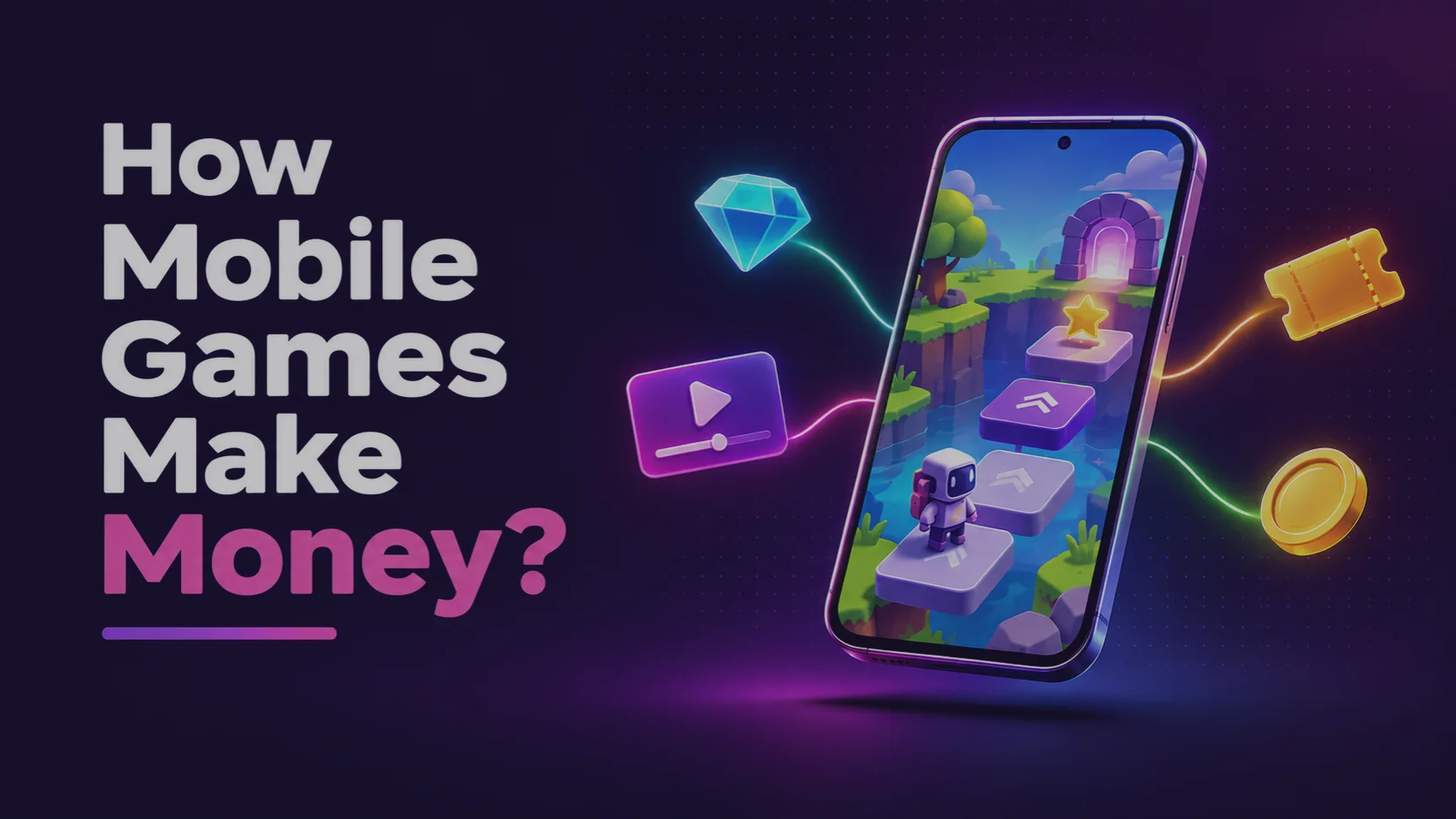
Most mobile games cost nothing to install, yet the industry is large. Sensor Tower counted 52 billion game downloads in 2025, and said the vast majority were on mobile. So where does the money come from? The short answer: a small share of players spend money inside the game, and everyone else is shown ads. Some games also charge a subscription or an up-front price. This article explains each model in plain terms, what it costs the developer, and why earning money takes more than a free download.
Why Free Downloads Work
A price on the store page is a barrier. Free removes it, so more people install the game and try it. The developer then earns from what players do after they install, not from the install itself. Apple describes this as the freemium model: downloads are free, and optional in-app purchases add premium features, content, subscriptions or digital goods.
The Main Ways a Mobile Game Earns
| Model | Who pays | What it looks like |
|---|---|---|
| In-app purchases | Some players | Gems, lives, cosmetics, level packs |
| Advertising | Advertisers | Rewarded videos, interstitials, banners |
| Subscriptions | Some players | Monthly pass, season pass, ad-free tier |
| Paid download | Every player | One price, no extras |
| Hybrid | Players and advertisers | Two or more of the above in one game |
In-App Purchases
Apple's business-model guide lists four kinds. A consumable is used up and bought again, such as lives or gems in a game. A non-consumable is bought once and kept. An auto-renewable subscription charges on a schedule until the player cancels. A non-renewing subscription gives access for a limited time, such as a season pass, and does not renew by itself. Consumables and passes give players a reason to come back and buy again.
Spending is concentrated in very few players. Swrve, a mobile analytics firm, studied more than 20 million players across over 40 free-to-play titles in January 2015. It found that 2.3 percent of players made a purchase, and that only 0.23 percent of all players generated 60 percent of in-game revenue. Its 2016 report, covering one month, put paying players at 1.9 percent and found that about 64 percent of them made only one purchase. These figures are old and from one analytics firm, so read them as the shape of the pattern, not as today's exact numbers. The pattern is the point: a game does not need everyone to pay, but it does need a few to pay a lot.
Advertising
Players who never spend can still earn money for the developer by watching ads. Google's AdMob describes rewarded ads as ads that reward users for watching short videos and interacting with playable ads and surveys, and calls them suited to monetizing free-to-play users. The player gets a reward in the game for watching, such as an extra life or a bonus.
Other formats exist, such as full-screen ads between levels and banners at the edge of the screen. Advertisers pay for impressions, and developers often compare ad networks by eCPM, which means earnings per thousand impressions. Placement matters: AdMob warns that banners placed too close to other buttons cause accidental clicks, and that this can count as invalid activity and lead Google to stop serving ads to the app.
Sensor Tower's June 2026 ad-monetization report calls mobile advertising a mature ecosystem worth more than $12 billion. It says ad-supported games still account for the vast majority of downloads, that ads give a dependable revenue floor, and that in-app purchases scale a game's earning ceiling.
Subscriptions and Passes
A subscription turns one-off spending into regular spending. In games it usually appears as a monthly pass with daily rewards, a season or battle pass, or an ad-free tier. The player pays a smaller amount more predictably, and the developer gets income that is easier to forecast.
Paid Downloads
Some games charge once and include everything. Apple calls this the paid model: users pay once to download the app and get all of its functionality, with no further charges. It suits games with a clear, finished experience. The trade-off is that fewer people try a game they must pay for first.
Hybrid Models
Many games combine models. A player who will never buy gems can watch rewarded ads, and a player who dislikes ads can pay to remove them. Sensor Tower separates hybrid-casual games into two kinds: ads-first titles that earn most of their revenue from advertising, and IAP-first titles that run a full purchase economy and earn most from purchases. Mixing models is not free of cost. Showing ads can annoy players who might have spent money, so the balance is a design decision, not just a pricing one.
What the App Stores Take
Every purchase made through the stores is shared with the platform. Apple's Small Business Program lowers its commission to 15 percent on paid apps and in-app purchases for developers with up to 1 million US dollars in proceeds in the prior calendar year, and for new developers. Google Play's fee page lists 15 percent on the first 1 million dollars of annual revenue and 30 percent above that, and 15 percent on auto-renewing subscriptions, in markets where its older structure still applies. In some countries, including the US, UK, EEA, Australia and Japan, Google lists a different structure that adds a separate billing fee. Rates differ by country and by program and have been changing, so a developer should read the current pages before budgeting.
Why Earning Is Harder Than It Looks
Headline totals hide what it takes to earn them. Spending is concentrated in a small share of players, as the Swrve data above shows. Earning money also costs money: a developer pays to make the game, to bring players to it, and to keep them playing, and the stores take their share. Sensor Tower's 2025 data shows the market still moving. Revenue grew for a third year in a row across the App Store and Google Play, while downloads fell, and strategy was the only genre to grow downloads across Asia, North America and Europe. A game that reaches players but does not keep them, or keeps them but does not earn from them, can lose money.
Where Monetization Meets Regulation
How a game asks for money is now a legal matter in several countries. In the United States, the Federal Trade Commission's order against Epic Games, maker of Fortnite, requires it to pay 245 million dollars in refunds. The FTC said Epic used dark patterns to trick players into unwanted purchases, including a button layout that let one press trigger a charge, and the order bars charging players through dark patterns or without their affirmative consent.
In the UK, the Advertising Standards Authority issued an enforcement notice on 27 February 2026 on loot boxes in mobile game advertising and store listings. It says consumers must know before downloading or buying whether a game contains loot boxes, and that a generic label such as "offers in-app purchases" is not enough on its own. The ASA said it would begin active monitoring from 26 May 2026. A game that charges fairly and says clearly what players are buying avoids both the legal risk and the loss of trust.
Choosing a Model
There is no best model, only a fit between the game and its players. These questions help narrow it down:
- Does the game suit short, repeated sessions? Rewarded ads and consumables fit well.
- Is it a finished, self-contained experience? A paid download may fit better.
- Do players return daily? A pass or subscription gives them a reason to keep paying.
- Will the audience include children? Check the rules on purchases and loot boxes first.
- Can the game earn back what it costs to find players? If not, the model needs another look.
Frequently Asked Questions
It earns from a small share of players who buy items or passes inside the game, and from advertisers who pay to show ads to everyone else.
The figures we could open are old. Swrve measured 2.3 percent in January 2015 and 1.9 percent in February 2016. Treat them as an indication of how few players pay, not as a current rate.
It depends on the game. Sensor Tower describes ads-first titles that earn most of their revenue from advertising and IAP-first titles that earn most from purchases, and says ads give a revenue floor while in-app purchases raise the ceiling.
It varies by country, program and revenue. Apple lists 15 percent for developers in its Small Business Program. Google lists 15 percent on the first 1 million dollars a year in markets using its older structure, and 30 percent above that. Check the current platform pages.
It is a design that nudges people into something they did not intend, such as an accidental purchase. The FTC applied the term to its case against Epic Games, and the order bars charging players through dark patterns.
Sources
- Business modelsApple Developer
- App Store Small Business ProgramApple Developer
- Service feesGoogle Play Console Help
- Rewarded adsGoogle AdMob Help
- Banner ad placement guidelinesGoogle AdMob Help
- State of Gaming 2026Sensor Tower
- Gaming Deep Dive: Ad Monetization ReportSensor Tower
- In mobile games, 60% of revenues come from 0.23% of playersGamesBeat (Swrve 2015 data)
- Just 1.9 percent of mobile players make a purchaseGame Developer (Swrve 2016 data)
- FTC Finalizes Order Requiring Fortnite Maker Epic Games to Pay $245 MillionUS Federal Trade Commission
- New tough measures brought in by the ASA on advertising loot boxes in the UKLewis Silkin (summary of the ASA enforcement notice)
Planning a mobile game?
We design and build games for mobile and other platforms, including how the game earns.