Microlearning is teaching in short, focused units, usually a few minutes long, each built around one objective. It can work well, especially for refreshers, reminders and single skills. It is not a proven replacement for a full course, and the research behind it is thinner than the marketing around it.
We build interactive learning for clients, so we have a view, and we say below where something is our view and where it is evidence. The evidence is real but limited, and we point out where.
What Microlearning Means
There is no agreed definition. A 2024 systematic review of 40 studies describes microlearning as targeted, action-oriented content in small pieces, typically seconds to a few minutes, and says the term still lacks a universally accepted definition. An earlier scoping review of health professions education found that none of its 17 studies defined the term at all. What those studies shared was length: every one used units under 15 minutes, from a few seconds up to about a quarter of an hour.
The right length is not fixed either. The 2024 review calls the ideal duration subjective, and the studies it covers used units from about one minute to about fifteen. Choose the length the content needs, not a number from a blog post.
What the Evidence Says
What the Reviews Found
The 2024 systematic review, by Monib, Qazi and Apong in Heliyon, screened 3,613 records and included 40 studies published between 2020 and 2024. It reports gains in knowledge, retention, recall, confidence and motivation. It is a narrative review, so it does not combine the results into one effect size. Its own comparisons are mixed: some included studies found microlearning beat a traditional method for knowledge gained, and others found it about as good as face-to-face teaching.
The 2019 scoping review of health professions education, by De Gagne and colleagues in JMIR Medical Education, screened 3,096 references and included 17 studies. Almost all measured how learners reacted (16 of 17), and most measured knowledge or skill (14 of 17). Five measured any change in behavior. None measured results such as effects on patients or practice. The authors did not rate study quality, by design, because the aim was to map the field, and they note that the participants skewed young.
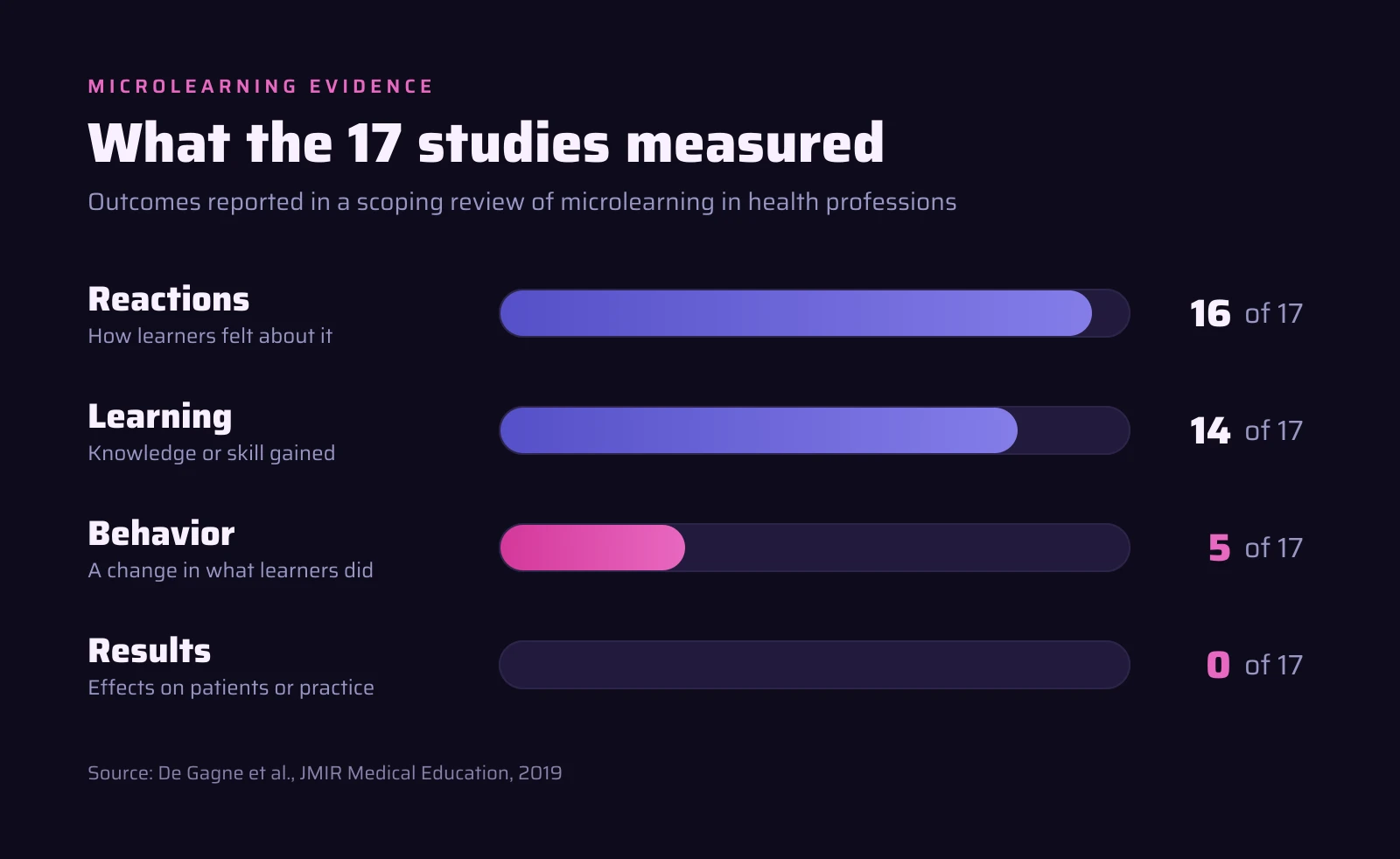
Read together, the reviews support a modest claim. Learners tend to like short units, and many studies show they learn from them. Little of this research shows that microlearning changes what people do at work. In our reading, neither review settles whether short units beat longer ones on the same content, which is the question most people actually ask.
Why Short Units Might Help
Three findings from learning science are often given as reasons. None of them tested microlearning, so treat them as plausible mechanisms, not proof.
- Spacing. A 2006 review by Cepeda and colleagues combined 839 assessments from 317 experiments in 184 articles. It found a benefit from spacing study sessions apart, and that the best gap grows with how long the learner needs to remember. It covered verbal recall tasks, so it speaks most clearly to facts and terms.
- Retrieval. In a 2006 study, Roediger and Karpicke had students read prose passages and then either restudy them or take recall tests. Restudying helped most on a test five minutes later. On tests two days and one week later, the students who had been tested remembered much more, even though restudying had made the others feel more confident.
- Segmenting. Mayer's multimedia learning research includes a segmenting principle: break content into smaller pieces that learners move through at their own pace, as summarized by Lisa Hammershaimb in 2019.
The catch is that a short format makes spacing and testing easy but does not provide either one. Twelve short videos released on the same day, with no questions, get neither benefit. That is our reading, and it is why the design advice below is about spacing and practice, not about length.
When Microlearning Works
This is our view, with a note where a review supports it. Short units fit best in these cases:
- Refreshers. The 2019 review points to microlearning as a way to refresh knowledge before a rarely used or new procedure.
- Reinforcing a longer course. Short follow-ups spread over weeks give the spacing effect something to work with.
- One fact or skill at a time. A single objective is easy to test and easy to retake.
- Learners with little time. The 2019 review lists flexibility and convenience among the benefits.
- Updates that people need quickly. A change to a procedure is easier to deliver as one short unit than as a new course.
When It Does Not
Short units are a poor fit when a topic has many parts that depend on each other, or when a skill needs long practice. Both reviews record the concern. The 2024 review notes that some critics doubt microlearning can handle complex topics, and the 2019 review says some complex subjects are too difficult to teach through microlearning alone. The 2019 authors also list costs: building many small units takes time, recorded lessons can leave learners passive, and not every learner has equal access to the technology.
Context matters too. Operating a machine safely means reading the gauge, making a choice and seeing the consequence. In our view, a three-minute clip can introduce that, but it cannot replace practicing it in a realistic scenario.
| Learning goal | Fit for microlearning | Why |
|---|---|---|
| Refresh a rarely used procedure | Good | A short reminder close to the moment of need |
| Keep a course's key points alive | Good | Spaced reminders and questions |
| Teach one new fact or term | Good | One objective, easy to test |
| Build a skill with many dependent parts | Weak on its own | Needs sequence and extended practice |
| Practice decisions under realistic conditions | Weak on its own | Needs a scenario or simulation, not a clip |
How to Design Microlearning That Works
This section is our view. It follows from the evidence above and from how we design lessons.
- One objective per unit. If the title needs the word "and", split it.
- Ask for something in every unit. A question, a choice or a small task. Retrieval is where the testing effect comes from.
- Space the units. Release them over days or weeks, and bring the important ones back later in new situations.
- Show how the pieces fit. A simple path or map tells learners where each unit sits in the whole.
- Make each unit as long as it needs to be. The research gives no magic number.
- Measure what learners did. Knowing that someone opened a unit says little. Reporting standards such as xAPI can record more, and we explain what each can and cannot record in SCORM and xAPI Explained.
For an example of a short lesson that asks the learner to act, watch the 60-second demo near the top of our article on why e-learning often fails.
Frequently Asked Questions
There is no proven number. The reviews describe units from a few seconds to about fifteen minutes, and one calls the ideal length subjective. Start from the objective. If one idea needs six minutes, use six.
No. Mobile learning is about where a lesson is delivered. Microlearning is about how big the lesson is. Short units are often delivered on phones, but neither one requires the other.
The research does not say so in general. The reviews report learning gains and positive reactions, and some studies found short units about as good as traditional teaching, not better. Whether it works better depends on the goal, the content and how the units are designed.
For a refresher or a single skill, often yes. For a topic with many dependent parts, or one that needs long practice, usually not on its own. It works well as a follow-up around a longer course.
You need some way to deliver the units and record what learners did. A learning management system can do both. If you want more than completion data, ask that the course report performance, and check that your system can receive it.
Sources
- Microlearning Beyond Boundaries: A Systematic Review and a Novel Framework for Improving Learning OutcomesHeliyon
- Microlearning in Health Professions Education: Scoping ReviewJMIR Medical Education
- Distributed Practice in Verbal Recall Tasks: A Review and Quantitative SynthesisPsychological Bulletin
- Test-Enhanced Learning: Taking Memory Tests Improves Long-Term RetentionPsychological Science
- Designing Online Learning Spaces (3): A Picture Is Worth a Thousand Words? A Summary of Mayer's 12 Principles of Multimedia LearningAACE Review
Planning short lessons for your team?
We design interactive lessons and scenarios for clients. Tell us the skill, how often people need it and what you need to measure, and we will say whether short units fit.