Clients usually arrive asking for "VR" or "AR" by name. The more useful question is what the project is meant to achieve, because the right technology depends on whether people need to see their real surroundings while they work, need to be fully immersed, or need something in between. Starting from the acronym instead of the task is the most common reason an immersive project ends up with the wrong hardware.
This guide covers four terms: extended reality (XR), virtual reality (VR), augmented reality (AR) and mixed reality (MR). It explains what each one means, what each costs you beyond the headset, and how to choose between them.
The Short Answer
What Each Term Means
The Khronos Group, which maintains the OpenXR standard, describes AR and VR as "collectively known as XR". That is the sense we use here: XR is the family name, and VR, AR and MR are members of it.
| Term | What the user sees | Typical hardware | Best fit |
|---|---|---|---|
| Extended reality (XR) | Any of the three below | Depends on the type | A category, not a product |
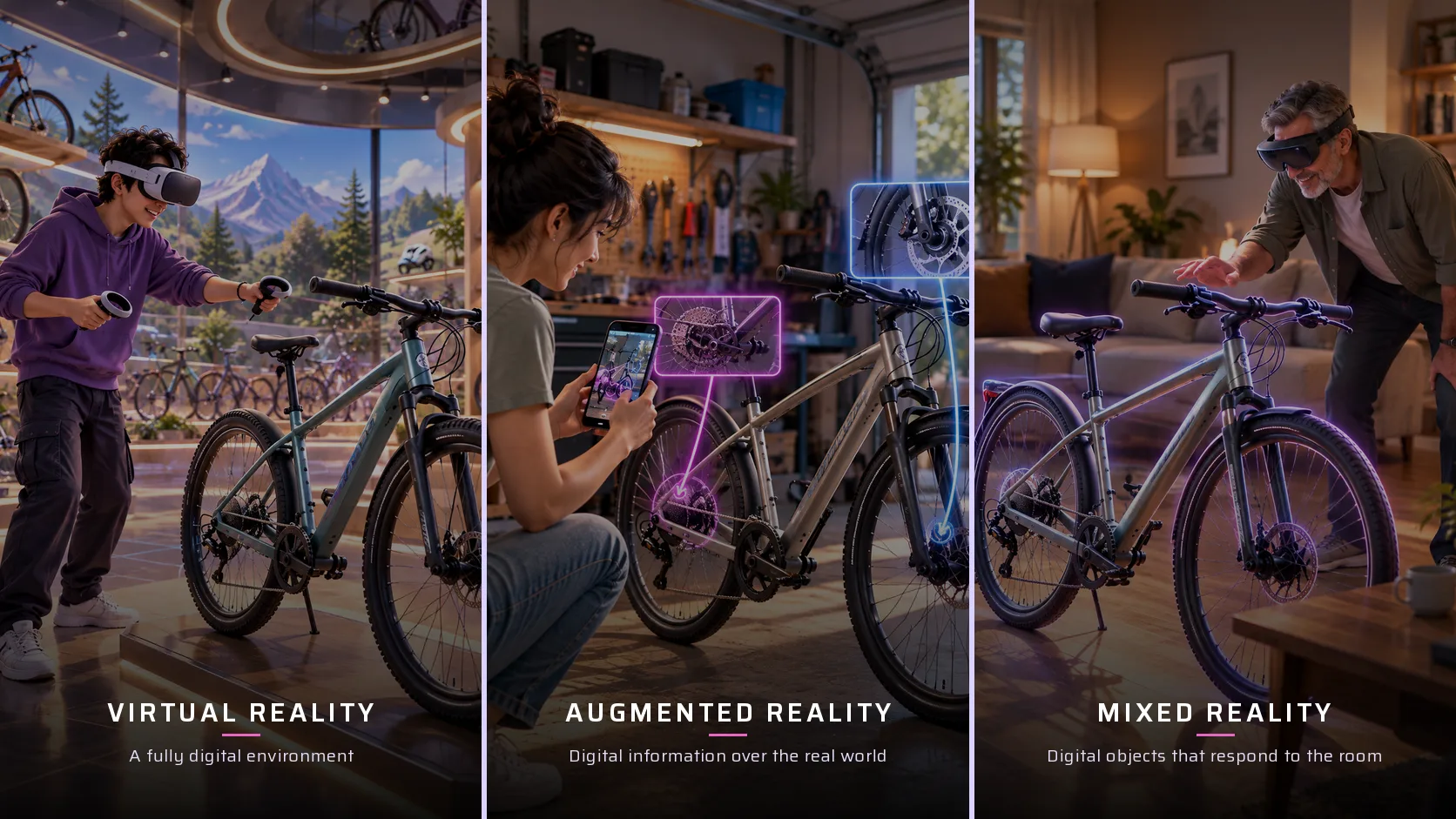
| Virtual reality (VR) | A fully digital environment | Headset and controllers | Practice where the real thing is risky or costly |
| Augmented reality (AR) | Digital information over the real world | Phone, tablet or headset | Work done on real equipment |
| Mixed reality (MR) | Digital objects that respond to the room | Headset with passthrough | Objects that must respect real space |
One caution on MR. The term was introduced in 1994 by Paul Milgram and Fumio Kishino. A 2021 paper in Frontiers in Virtual Reality, which revisits their work, summarizes their definition as "any environment which consists of a blending of real and virtual objects". That makes AR a kind of MR. Today the word is used less consistently. The same paper quotes earlier work by Speicher and colleagues, which found that MR "has been defined as a combination of AR and VR, as a synonym for AR, as a 'stronger' version of AR, or as Milgram and Kishino defined it". When a vendor says "mixed reality", ask what the system actually does with the room.
How to Choose by Task
- Do people need to see the real equipment while they work? Choose AR. It overlays instructions on a machine instead of recreating the machine, which suits maintenance and on-site work.
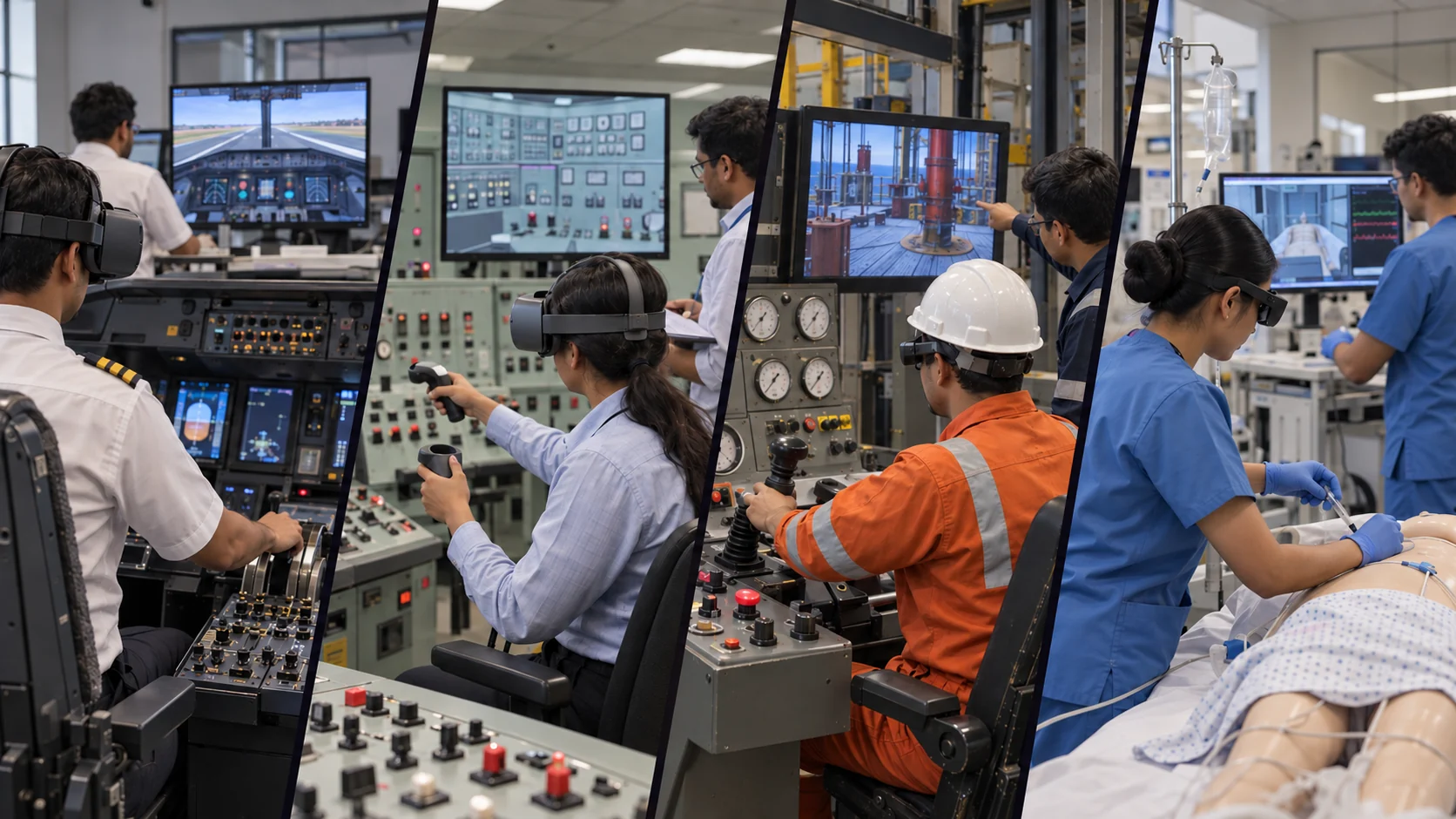
- Is the real thing dangerous, expensive or unavailable? Choose VR. A trainee can enter a virtual factory or rehearse an emergency without touching the actual machine.
- Must digital objects respect the physical space? Choose MR, for example when someone walks around a virtual machine anchored to their actual floor. It is the costliest and most delicate of the three to deploy at scale because of its tracking and hardware requirements, so we recommend it only when real-world grounding is essential rather than optional.
- Do you need to reach people outside your company, or launch once? Consider WebXR, which runs in a compatible browser with no app install. The W3C specification covers VR and AR devices on the web. The trade is performance headroom, so it suits lighter experiences and not visually heavy ones.
Does XR Training Actually Work?
A 2021 meta-analysis in the journal Human Factors, by Kaplan and colleagues, pooled the empirical findings on training transfer from VR, AR and MR. It found that training in XR did not produce a different outcome from training in a non-simulated control environment. The authors read this as XR being equally valuable for skill development, with its main advantage being that it makes training possible where conventional methods are impractical, such as high-risk or high-cost situations.
That matches how we frame the decision. XR is not automatically better than a classroom or a video. It earns its cost when the real task is hard to practice any other way.
What Each One Costs Beyond the Headset
VR has two costs that are easy to miss. The first is space and safety. Room-scale tracking, where the system follows you as you walk, crouch and lean, needs a clear physical area, and that detail gets overlooked when a rollout is planned. The second is simulation sickness.
A 2020 systematic review and meta-analysis in Frontiers in Human Neuroscience, by Saredakis and colleagues, covered 55 articles and 3,016 participants using VR headsets. The pooled total score on the Simulator Sickness Questionnaire was 28.00 (95% CI 24.66 to 31.35), which the authors describe as relatively high compared with recommended cut-off scores. Visual stimulation, locomotion and exposure time all influenced the results. The review looked at VR headsets only, but the lesson carries over to any design that moves the user's view: treat session length as a design limit, not a footnote.
MR adds a hardware cost, and the line between VR and MR is blurrier than the acronyms suggest. Meta describes passthrough as "a real-time and perceptually comfortable 3D visualization of the physical world on Meta VR devices", which developers blend with virtual content. In other words, some VR headsets can run MR experiences. Meta's documentation also states that apps cannot access images or videos of the user's physical environment.
Common Mistakes
- Choosing the hardware first and the task second.
- Paying for MR when AR would do the job.
- Planning long sessions without testing how your trainees feel after the first few minutes.
- Assuming immersive means better, when a major meta-analysis found XR training performs no differently from non-simulated training and is valuable mainly where other methods cannot go.
Frequently Asked Questions
Extended reality. It is the umbrella term for virtual, augmented and mixed reality. Khronos, the group behind OpenXR, describes AR and VR as "collectively known as XR".
Not consistently. Under the original 1994 definition, AR is one kind of MR. In current usage the terms vary by vendor, and some treat MR as a stronger form of AR. Ask what the system does with the physical space.
Neither is better in general. Choose by task: VR where the real thing is risky, costly or unavailable, and AR where people need to work on real equipment. Across studies, XR training has matched non-simulated controls, so the case for it rests on what it makes possible.
Some can. Meta's VR headsets offer passthrough, which shows the physical world inside the headset so that digital content can be blended with it. Check the specific device and the features it supports.
Sometimes. WebXR runs VR and AR experiences in a compatible browser, which suits one-time launches and audiences outside your company. It gives up some performance headroom and device features.
Some people will feel discomfort, whatever the quality of the design. A 2020 meta-analysis found pooled sickness scores that were relatively high compared with recommended cut-offs, and that locomotion and exposure time mattered. Plan shorter sessions and test with real users.
Sources
- OpenXR: High-performance access to AR and VR, collectively known as XRKhronos Group
- Revisiting Milgram and Kishino's Reality-Virtuality ContinuumFrontiers in Virtual Reality, 2021
- The Effects of Virtual Reality, Augmented Reality, and Mixed Reality as Training Enhancement Methods: A Meta-AnalysisHuman Factors, 2021
- Factors Associated With Virtual Reality Sickness in Head-Mounted Displays: A Systematic Review and Meta-AnalysisFrontiers in Human Neuroscience, 2020
- Passthrough for UnityMeta
- WebXR Device APIW3C
Not sure which one you need?
Tell us the task, and we will tell you which kind of XR fits it, including when the answer is none of them.