
A VR training session only works if the trainee stays in the headset. Regardless of how well an experience is designed, some people in any group will feel unwell, and pretending otherwise leads to poor deployment plans. The useful question is not whether it will happen, but how much of it your design causes and how much of it you can remove.
This guide covers what VR motion sickness is, how common it is, what makes it worse, and which fixes have evidence behind them. It is part of our wider look at virtual reality (VR), and it builds on our earlier guide to choosing between VR, AR, MR and XR.
The Short Answer
What VR Motion Sickness Is
Meta's comfort guidance gives the core idea in one sentence: "Motion sickness can occur when there is a mismatch between what the user sees and how they move." In VR, your eyes report movement through a virtual space while your inner ear reports that you are standing or sitting still.
Papers and product teams use several names for this problem. Researchers write cybersickness or VR sickness, and our glossary uses simulation sickness. A 2024 systematic review in Neurologia, covering 10 studies and 416 participants in therapeutic uses of VR, found that side effects were reported more often with head-mounted displays than with desktop systems, especially disorientation, followed by nausea and oculomotor disturbances such as eye strain.
How Common Is It?
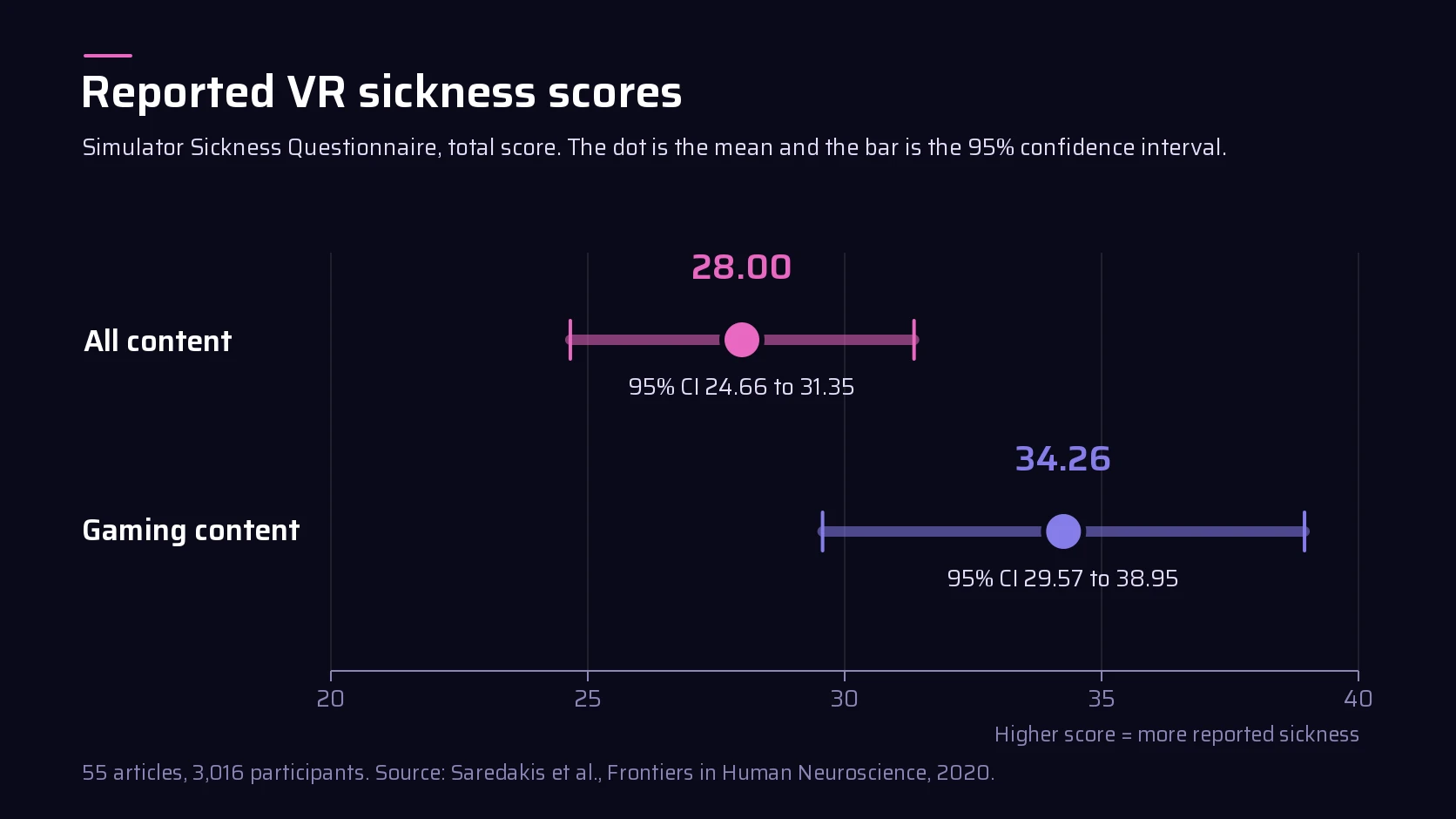
A 2020 systematic review and meta-analysis in Frontiers in Human Neuroscience, by Saredakis and colleagues, covered 55 articles and 3,016 participants using VR headsets. The pooled total score on the Simulator Sickness Questionnaire was 28.00 (95% CI 24.66 to 31.35), which the authors describe as relatively high compared with recommended cut-off scores. Gaming content scored highest, at 34.26 (95% CI 29.57 to 38.95).
Two details matter for planning. First, the scores describe symptom severity on a questionnaire, not the share of people who felt sick. Second, the results moved with content: visual stimulation, locomotion and exposure time all influenced the sickness profiles.
Who feels it is less predictable than people assume. The same review found no sex differences, and older samples (mean age 35 or above) scored significantly lower than younger ones, though the authors note that few studies included older users. A 2023 systematic review in the Journal of the American Geriatrics Society, which included 39 studies, found that most reported only minor cybersickness among older adults, although most studies were single sessions. Do not assume anyone is immune or especially at risk. Test with the people who will actually use it.
What Makes It Worse
- Smooth, continuous movement. Meta's locomotion guidance recommends avoiding sudden acceleration, rapid direction changes and unnatural camera movements, and favors teleportation and snap turning over continuous movement.
- Dropped frames. Meta's performance guidelines say plainly: "Dropped frames that cause discomfort are not worth better quality graphics." This is why performance optimization matters more in VR than in most software.
- Long exposure. Exposure time was one of the factors that influenced sickness in the Saredakis review.
- Content and visual stimulation. The same review found that the type of content mattered, with gaming content scoring highest.
What Reduces It
The table separates what vendors recommend from what controlled studies found. Both are useful, but they are not the same strength of evidence.
| Technique | What it does | What backs it |
|---|---|---|
| Steady frame rate | Avoids judder between frames | Meta guidance |
| Teleport or stepped movement | Replaces continuous motion with jumps | Meta guidance |
| Snap turning | Removes smooth rotation | Meta guidance and a 201-person study |
| Narrower view while moving | Darkens the edges to limit visible motion | Meta guidance and a 201-person study |
| A stable visual reference | Gives the eyes something that stays still | Meta guidance |
| Seated mode and user settings | Lets people pick what suits them | Meta guidance |
The 201-person study is Kelly and colleagues, published in 2025 in IEEE Transactions on Visualization and Computer Graphics. Participants played a consumer VR game, and both field of view restriction and snap turning on their own reduced cybersickness compared with no mitigation. The surprise came next: the combination did not reduce it further, and in some cases it led to cybersickness similar to no mitigation at all. More fixes are not automatically better. Test the combination you ship, not each fix in isolation.
Meta's guidance also describes quantized speeds, where movement switches instantly between set speeds such as stopped, walking and running, and soft camera collisions, where the camera slows before stopping instead of halting abruptly. It recommends consistent control schemes and customizable settings for user preferences and abilities.
Repeated Exposure Helps
People adapt. Doty and colleagues (IEEE Transactions on Visualization and Computer Graphics, 2025) had one group play a VR game for up to 20 minutes on four separate days, with field of view restriction on days one to three and none on day four. By day four, their cybersickness was significantly lower than that of a group playing without restriction for the first time. A follow-up by Kelly and colleagues in 2026 found that this abatement carried over to a different game with a different environment, task and locomotion interface, and the authors conclude that the results support systematic exposure as a way to reduce cybersickness.
A caution on scope: these were consumer games played for up to 20 minutes, not workplace training. Our reading is that it favors several short early sessions over one long one, but your own pilot should confirm it.
Does Feeling Present Help?
A 2019 review in Frontiers in Psychology by Weech and colleagues concluded that presence, the sense of being there in the virtual space, and cybersickness are negatively related, driven principally by sensory integration processes. Experiences with a stronger sense of presence tend to come with less sickness, not more. The authors say that more research with greater statistical power is needed, so treat this as a direction, not a rule.
What This Means for a Training Rollout
- Pilot with real trainees before a full rollout, and ask how they feel, not only whether they finished.
- Budget for frame rate first. A visual upgrade that costs you frames is a bad trade.
- Offer comfort options. Teleport and snap turn as defaults, smooth movement as a choice, and a seated mode.
- Start short and build up. Use brief first sessions, then lengthen them as people adapt.
- Let anyone stop. Taking the headset off should carry no penalty.
- Ask whether movement is needed at all. If the task can be learned standing in one place, you remove the biggest trigger.
Frequently Asked Questions
They are closely related names for discomfort caused by virtual environments. Papers tend to use cybersickness or VR sickness, and our glossary uses simulation sickness. This guide calls it VR motion sickness.
Results vary by person, and group averages do not predict an individual. A 2020 meta-analysis found no sex differences and lower scores in older samples, but the older-user evidence base was small. Test with your own users.
Studies of repeated exposure found lower cybersickness on later days, including in a different game from the one played earlier. Those studies used sessions of up to 20 minutes, so confirm the effect on your own content.
It helps. A 2025 study of 201 participants found that restricting the field of view reduced cybersickness compared with no mitigation, but combining it with snap turning did not reduce it further.
Meta's guidance favors teleportation and snap turning over continuous movement for comfort, and also recommends customizable settings for user preferences and abilities, so offer a choice where you can.
No source we opened sets a safe session length, and Meta's comfort guidance does not prescribe one. Exposure time did influence sickness in the 2020 meta-analysis, so start with short sessions and lengthen them based on what your pilot shows.
Sources
- ComfortMeta Horizon OS developer documentation
- Locomotion Comfort and UsabilityMeta Horizon OS developer documentation
- Guidelines for VR Performance OptimizationMeta
- Factors Associated With Virtual Reality Sickness in Head-Mounted Displays: A Systematic Review and Meta-AnalysisFrontiers in Human Neuroscience, 2020
- Cybersickness. A Systematic Literature Review of Adverse Effects Related to Virtual RealityNeurologia, 2024
- In Too Deep? A Systematic Literature Review of Fully-Immersive Virtual Reality and Cybersickness Among Older AdultsJournal of the American Geriatrics Society, 2023
- Field of View Restriction and Snap Turning as Cybersickness Mitigation ToolsIEEE Transactions on Visualization and Computer Graphics, 2025
- Cybersickness Abatement From Repeated Exposure to VR With Reduced DiscomfortIEEE Transactions on Visualization and Computer Graphics, 2025
- Cybersickness Abatement From Repeated Exposure Generalizes Across ExperiencesIEEE Transactions on Visualization and Computer Graphics, 2026
- Presence and Cybersickness in Virtual Reality Are Negatively Related: A ReviewFrontiers in Psychology, 2019
Planning a VR rollout?
Tell us who will use it and for how long, and we will plan comfort into the design from the start.